Do Solar Panel Installers Need Scaffolding in Sydney? A Complete Guide
Do Solar Panel Installers Need Scaffolding in Sydney? A Complete Guide
Installing solar panels is a popular way for Sydney homeowners to generate renewable energy and reduce their electricity costs. However, rooftop solar installation involves working at height, moving equipment onto the roof and working around roof edges, fragile surfaces and electrical systems.
One of the most common questions homeowners and solar installers ask is:
Do solar panel installers need scaffolding?
The answer is: not every solar installation will use the same access system, but safe roof access and fall protection must be properly planned for every job. Depending on the property, roof design, height, access requirements and installation method, scaffolding can be an effective solution for providing safe access and fall protection.
Why Is Scaffolding Important for Solar Panel Installation?
Solar panel installation generally requires workers to access a roof, carry or move equipment and work near roof edges.
This creates several potential risks, including:
- Falls from roof edges
- Falls through skylights or fragile roofing
- Slips and trips on sloping roofs
- Falling tools, equipment or panels
- Difficult roof access and egress
- Manual handling injuries
- Electrical hazards
SafeWork NSW identifies falls from heights as one of the key risks associated with rooftop solar installation. Solar retailers and installers have responsibilities to ensure appropriate safety controls are in place before work begins.
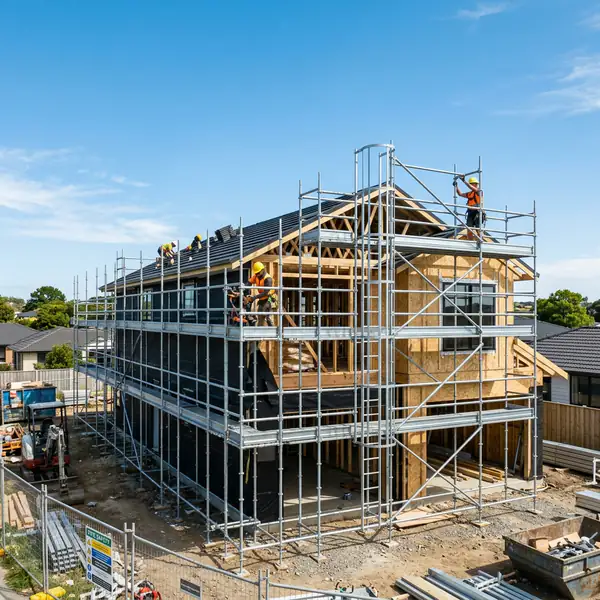
A properly planned residential scaffolding system can provide a stable working platform, safer roof access and physical protection around exposed roof edges.
Does Every Solar Installation Require Scaffolding?
No two solar installation sites are exactly the same.
The appropriate access and fall-protection system depends on factors such as:
- Roof height
- Roof pitch
- Roof shape and design
- Roof condition
- Location of skylights or fragile roofing
- Distance from the roof edge
- Number of workers accessing the roof
- Size and number of solar panels
- How panels and equipment will be lifted
- The surrounding work area
- The installation method and site-specific risk assessment
SafeWork NSW advises that solar installers establish safe access and egress to the roof and select controls appropriate to the specific site.
This means the question should not simply be:
"Do solar installers need scaffolding?"
A better question is:
"What is the safest and most suitable access and fall-protection system for this particular solar installation?"
If you're wondering how scaffold rules apply to other elevated roof projects, read our guide on do I need scaffolding for roof repairs in Sydney?.
When Can Scaffolding Be a Good Option?
Scaffolding can be particularly useful when solar installers need regular access to the roof and when a stable working platform or physical edge protection is appropriate.
For example, scaffolding may be considered for:
Two-Storey Homes
Double-storey homes can present greater access challenges because of the increased working height.
A properly designed scaffold system can provide a controlled access point and working platform around suitable areas of the building.
Steep or Difficult Roofs
A steep or complex roof can make movement more difficult for installers.
Scaffolding can provide access from below while reducing the need for workers to rely solely on ladders for movement between ground and roof level.
Larger Solar Installations
Larger installations may involve more workers, more panels and more equipment.
For larger installations, temporary scaffold stairways or mobile scaffolds can be an efficient option for roof access where suitable for the site and task.
Homes With Difficult Roof Access
Some properties have limited side access, extensions, garages, landscaping or other obstacles that make normal roof access more challenging.
A site-specific assessment can help determine whether scaffolding, mobile scaffolding, an elevated work platform or another access method is suitable. For property owners preparing for trades at height, reviewing our scaffolding safety checklist for home renovations in Sydney can help you inspect ground access and site clearance ahead of time.
What About Single-Storey Homes?
Being a single-storey home does not automatically mean scaffolding or other fall-prevention controls are unnecessary.
Fall-prevention controls still need to be considered for rooftop solar installation work, including on one-storey homes.
The appropriate control will depend on the circumstances of the job.
For some properties, roof guardrails may be suitable. For others, scaffolding or another temporary work platform may provide a more practical solution.
Scaffolding vs Roof Guardrails for Solar Installation
Scaffolding and roof guardrails can both form part of a fall-prevention strategy, but they serve different purposes.
Scaffolding can provide:
- A working platform
- Roof access
- Access around sections of the building
- A platform for certain installation tasks
- Physical protection around suitable roof edges
Roof guardrails can provide:
- Physical edge protection
- Protection around roof edges
- A controlled perimeter for roof work
The correct solution depends on the property and the work being performed.
Higher-order fall-prevention controls such as roof guardrails and scaffolding should be considered where reasonably practicable before relying on lower-order controls such as harness-based systems.
What About Mobile Scaffold Hire?
Mobile scaffolding can be useful for certain solar installation projects where installers need a movable access platform.
Mobile scaffolding can be an option for roof access on suitable projects, particularly where mobility and access are important.
However, mobile scaffolding is not automatically suitable for every roof or site.
The scaffold needs to be appropriate for the task, correctly positioned and used in accordance with its design and manufacturer's requirements.
For solar installers, this can make mobile scaffold hire in Sydney a useful option for suitable projects where mobility and access are important. If you are weighing up mobile options against perimeter structures, see our detailed guide on mobile scaffold hire vs fixed scaffolding.
What About Moving Solar Panels Onto the Roof?
Access isn't only about getting workers onto the roof.
Solar panels and installation equipment also need to be moved safely.
Solar panels can be large and awkward to handle, creating manual-handling and falling-object risks.
Suitable panel handling and lifting equipment should be considered depending on the job.
A properly planned access system can help installers organise the movement of people, tools and equipment around the worksite.
Scaffolding Can Also Help With Edge Protection
Roof edges are one of the major hazards during rooftop work.
A scaffold system can sometimes be configured to provide temporary edge protection around appropriate sections of a building.
However, scaffolding should be designed, erected, altered and dismantled appropriately for the specific application.
Scaffolding can also be used as temporary edge protection where the relevant requirements are met. For a detailed overview of perimeter protection rules in NSW, read our guide on edge protection requirements in NSW.
This is particularly important because solar installation work can involve workers moving around the roof while positioning panels, rails, cables and other components.
What About Skylights and Fragile Roof Materials?
Solar installers need to consider more than just the roof edge.
Skylights, older roof sheets and other fragile areas can present a serious fall-through risk.
Installers should identify fragile or non-trafficable roof areas and implement appropriate controls before work begins.
Depending on the circumstances, controls may include:
- Covers
- Guardrails
- Temporary work platforms
- Safety mesh
- Appropriate roof access systems
- Other suitable fall-prevention measures
A solar installer should never assume that a roof surface is safe simply because it appears walkable.
Does Solar Installation Require a SWMS?
Where the work involves high-risk construction work, the appropriate safe work method statement (SWMS) requirements apply.
Solar installation work may involve high-risk activities such as working at height, and the applicable requirements should be determined for the particular job.
The SWMS and site assessment should help identify the hazards and determine the controls required for the particular installation.
This is another reason why access arrangements should be considered before the solar installation begins, rather than after workers arrive at the property.
When Should Scaffolding Be Arranged?
If scaffolding is identified as an appropriate access or fall-protection solution, it should be arranged before the solar installation team arrives.
This allows the scaffolding requirements to be considered as part of the project planning process. For a complete look at planning access timelines and requirements, refer to our homeowner's guide to residential scaffolding in Sydney.
Solar installers and homeowners should consider:
- The roof height and pitch
- Roof access points
- Available space around the property
- Location of powerlines and other hazards
- Skylights and fragile roof areas
- How panels will be moved
- Where workers will access the roof
- Required edge protection
- The duration of the installation
- How the equipment will be installed and removed
Good planning can reduce delays and help the installation team start work with the appropriate access arrangements already in place.
Can Tri Build Projects Provide Scaffolding for Solar Installers?
Yes. Tri Build Projects provides residential scaffolding and roof access scaffolding across Sydney for suitable residential construction and trade projects.
Our services include:
- Residential Scaffolding
- Roof Access Scaffolding
- Mobile Scaffold Hire
- Edge Protection
- Scaffold Erect & Dismantle
- Builder & Roofer Access Solutions
- Temporary Fence Hire
- Portable Toilet Hire
For solar installation projects, the appropriate access solution depends on the property, roof and work requirements.
If you're a solar installer, builder, roofer or homeowner in Sydney planning rooftop work, Tri Build Projects can discuss the access requirements for your project.
Frequently Asked Questions
Do solar panel installers need scaffolding in Sydney?
Not every solar installation will use the same access system. The required controls depend on the specific roof, height, access requirements and installation method. Scaffolding can be an appropriate fall-prevention and roof-access solution for suitable projects.
Is scaffolding required for solar panels on a single-storey house?
A single-storey house does not automatically remove the need for fall protection. Appropriate fall-prevention controls still need to be considered for rooftop solar installation work.
Can mobile scaffolding be used for solar installation?
Mobile scaffolding can be suitable for some solar installation projects. It may provide a practical roof-access option where the site and task are suitable.
Is roof access scaffolding useful for solar installers?
Yes. Roof access scaffolding can provide a controlled way to reach the roof and may also form part of the fall-prevention arrangements, depending on the project.
Do solar installers need edge protection?
Solar installation work requires appropriate fall-prevention controls based on the risks identified at the site. Roof guardrails and scaffolding are examples of higher-order controls that may be considered.
Can scaffolding help move solar panels onto a roof?
Scaffolding can form part of a planned access and work platform arrangement, but the method for lifting and moving panels should be assessed separately. Suitable panel-handling or lifting equipment may also be required.
How early should solar installers arrange scaffolding?
If scaffolding is required, it is best to arrange it during the project planning stage so the access system can be installed before the solar installation work starts.
Can Tri Build Projects provide scaffolding for solar installers in Sydney?
Tri Build Projects provides residential scaffolding, roof access scaffolding, mobile scaffold hire and edge protection solutions across Sydney for suitable projects.
Final Thoughts
Solar panel installation is more than simply placing panels on a roof. Installers need to consider safe roof access, fall prevention, fragile roof surfaces, edge protection, equipment movement and the overall worksite setup.
Scaffolding is not necessarily the answer for every property, but it can be a practical and effective solution for many residential solar installation projects.
If you're planning a rooftop solar installation and need scaffolding, roof access or edge protection in Sydney, speak with your solar installer about the required controls and contact Tri Build Projects to discuss a suitable access solution.
Tri Build Projects
Phone: 0489 150 675
Website: tribuildprojects.com.au
Email: info@tribuildprojects.com.au
Safe Access. Secure Sites. Sydney Wide.
Important Disclaimer: Safety requirements depend on the specific site and work activity. This article provides general information and should not be treated as a substitute for a site-specific risk assessment, SWMS or professional safety advice.
Need professional scaffolding or site access solutions?
Contact Tri Build Projects today for a FREE site inspection and no-obligation quote.